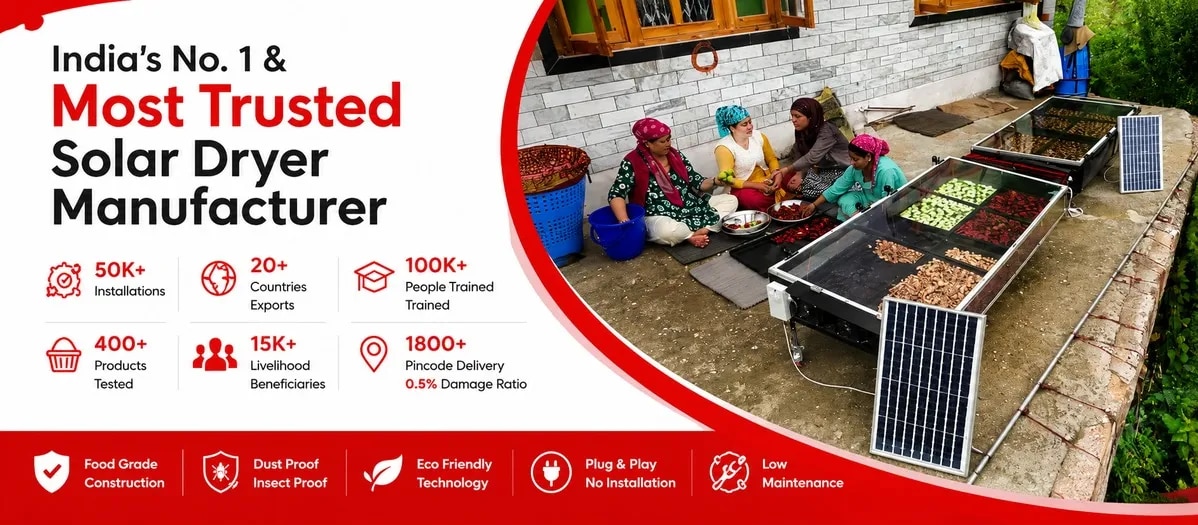
Commercial Solar Dryers for FPOs SHGs and Food Processing Businesses
Introduction
Solar thermal technology has applications beyond electricity generation. It can also be used to provide heat for agricultural processing, cooking, drying and other applications. Solar drying is particularly relevant where suitable crops or food products need moisture reduction and where sunlight is available for part of the processing cycle.
Rudra Solar Energy is an Indian solar thermal manufacturer offering solar dryers alongside solar cookers, ovens and desalination systems. The company states that it engineers and manufactures its systems and supplies solar thermal equipment across India.
Solar Thermal Energy for Drying
The fundamental principle is conversion of solar radiation into useful heat. In a dryer, that heat raises the temperature of air and supports moisture removal from the product.This is different from photovoltaic electricity generation. A solar thermal dryer directly uses heat rather than first converting sunlight into electricity.
Why Thermal Design Matters
Effective drying depends on more than heat collection. The heated air must interact with the product and moisture must be carried away.The system therefore needs appropriate airflow and product loading.
Rudra Solar Energy's Dryer Range
Rudra Solar Energy currently lists several types of solar dryers. These include cabinet dryers, fruit dryers, vegetable dryers, spice dryers, herb dryers, fish dryers, grain dryers, flower dryers, oilseed dryers, pulse dryers and seed dryers. :contentReference[oaicite:65]index=65The general cabinet range is stated to cover 5 kg per batch to 500 kg per batch.
Why Multiple Models Exist
Different products have different drying characteristics. An application-specific dryer can be evaluated around the commodity and process instead of treating every product identically.Enclosed Solar Drying
One major distinction between modern solar dryers and open-sun drying is enclosure.Rudra Solar Energy states that its solar dryer systems provide hygienic enclosed drying and that products remain protected from direct exposure to dust, Solar Dryer Supplier rain and pests.
Operational Advantages
An enclosed system can also make tray loading and unloading more organised. The operator can follow a defined process rather than spreading produce over an outdoor surface.Energy and Operating Costs
Rudra Solar Energy states that solar dryers can reduce dependence on LPG, diesel, electricity or other conventional fuel-based drying methods where those are being used. :contentReference[oaicite:68]index=68The actual Solar Dryer In India financial effect depends on the baseline process.
Businesses should consider:
- Current drying energy source
- Energy consumed per batch
- Number of batches per season
- Solar availability
- Required backup operation
- Equipment and installation cost
- Maintenance requirements
Solar Drying and Agricultural Value Addition
Drying can transform a fresh agricultural product into a different form suitable for storage or further processing.For farmers and FPOs, this can create an additional processing step between harvest and sale. Rudra identifies FPOs and cooperatives among the groups using solar dryers for agricultural value addition.
Market Planning Is Essential
Processing a crop does not automatically create a market. Businesses need to understand customer requirements, packaging, pricing, transport and competition.A solar dryer should therefore be purchased as part of a defined business plan.
Choosing the Right System
The appropriate dryer depends on the product and quantity.Rudra Solar Energy recommends evaluating the crop or product, fresh input Know More quantity, processing frequency, moisture requirements, installation area, electricity availability and future expansion.
Questions for Buyers
A potential buyer can prepare:- Product name
- Fresh quantity per batch
- Expected number of batches
- Desired final condition
- Product preparation method
- Available solar exposure
- Installation space
- Power availability
- Need for backup
These details make equipment selection more precise.
Maintenance and Long Term Use
Solar drying equipment should be maintained as any other processing equipment. Cleaning, inspection and appropriate care can help maintain the working condition of the system.Glazing should be kept reasonably clean so that solar radiation can reach the heating surfaces effectively.
Conclusion
Solar thermal drying provides a practical way to use sunlight for suitable agricultural and food-processing applications. Rudra Solar Energy offers a broad range of solar dryers, from cabinet systems to application-specific and larger commercial configurations. :contentReference[oaicite:71]index=71The technology should be evaluated according to the actual product, quantity, moisture requirement, solar conditions, workflow and business model. Solar drying can reduce reliance on conventional thermal energy in appropriate applications, but the real benefit depends on how the system is used.
For farmers, FPOs, SHGs and food processors, a carefully selected solar dryer can become a useful component of a broader agricultural value-addition and food-processing strategy.